
Summary at a glance
Superpower is published at $199 a year for a 100+ biomarker panel, verified 2026-07-09.
Function Health is published at $365 a year for 160+ lab tests with two rounds of testing, verified 2026-07-08.
Superpower includes one panel per year; extra testing costs more, and an at-home draw is an add-on.
Function Health includes on-demand retesting and a clinician review of every result at roughly double the price.
Both require a blood draw, are HSA/FSA eligible, and are not a replacement for your own doctor.
This comparison is based on pricing and features each company published as of the verification dates shown, not on first-hand testing of either service. Blood-panel results for liver, kidney, heart, and hormone markers are screening information, not a diagnosis. State availability, tests included, and prices change often. Confirm current details on each provider's own site and discuss any result with a licensed clinician before acting on it.
Superpower vs Function Health: which blood-test membership fits?
Superpower and Function Health run on the same idea. You pay a yearly fee, get a wide blood panel, and read your results in an app with clinician input. They differ in price and depth.
As published, Superpower costs $199 a year for a 100+ biomarker annual panel superpower.com. Function Health costs $365 a year for 160+ lab tests, with testing twice a year plus on-demand options functionhealth.com.
Superpower is the cheaper option, and it adds a 24/7 care team. Function Health tests more markers and builds in more retesting.
Both need a blood draw. Both are HSA/FSA eligible. Neither one stands in for your own doctor.
Superpower's $199 fee, as published, covers one 100+ biomarker panel a year. Retesting the same markers within that year is an added cost.
How do Superpower and Function Health compare on price and features?
Both memberships sit in the same category: at-home-friendly blood testing built around a yearly panel and an app. The differences show up in three places: what you pay, how many markers you get, and how often you can retest.
Superpower lists 100+ biomarkers for $199 a year, drawn at one of 2,000+ Quest lab locations or through an at-home draw that costs extra superpower.com. Function Health lists 160+ lab tests for $365 a year, run through 2,000+ lab locations, with a clinician review attached to every result functionhealth.com.
The table below sets the published facts side by side. Prices and inclusions reflect each site as of the verification dates.
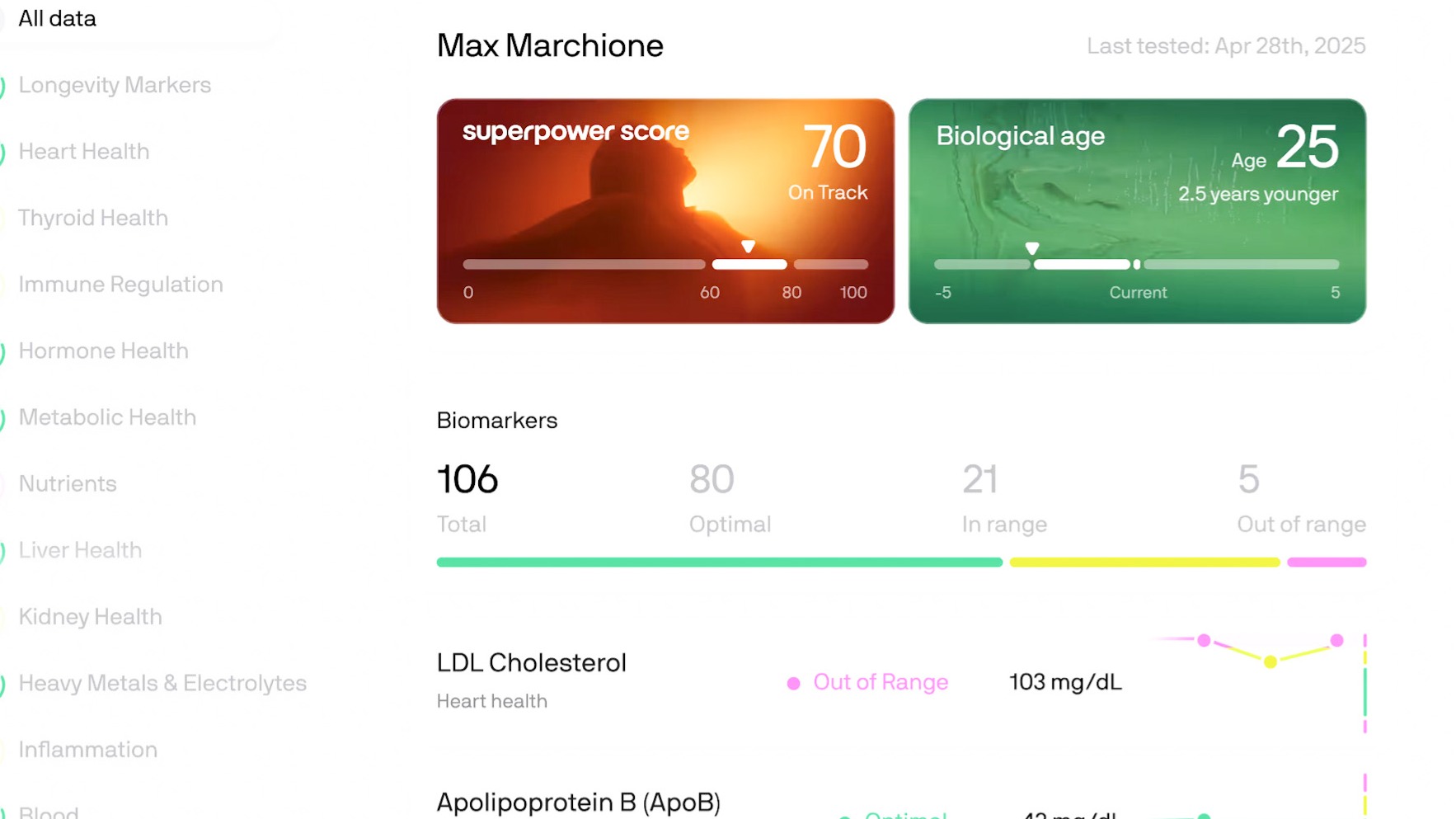 Superpower biomarker dashboard showing health scores from the annual panel
Superpower
$199 / year
Function Health
$365 / year
Superpower
100+ biomarkers
Function Health
160+ lab tests
Superpower
1 annual panel; add-ons cost extra
Function Health
2x/year + on-demand testing
Superpower
24/7 care team + concierge
Function Health
Clinician review of every result
Superpower
2,000+ Quest labs or at-home draw (extra)
Function Health
2,000+ lab locations
Superpower
Annual subscription
Function Health
Annual subscription
Superpower
Yes
Function Health
Yes
What are the pros and cons of Superpower?
Superpower offers breadth at a low entry price. For $199 a year you get 100+ biomarkers, 17 health scores, and a biological age readout, all as published on its site superpower.com.
Superpower's strongest feature is its support. Membership includes a 24/7 care team and concierge, plus add-on testing for toxins, gut, and cancer screening at member pricing.
Superpower has trade-offs. One panel is included per year. Extra testing costs more, and an at-home draw is a paid add-on. Coverage is also limited to certain US states, and the company publishes a no-refunds policy.
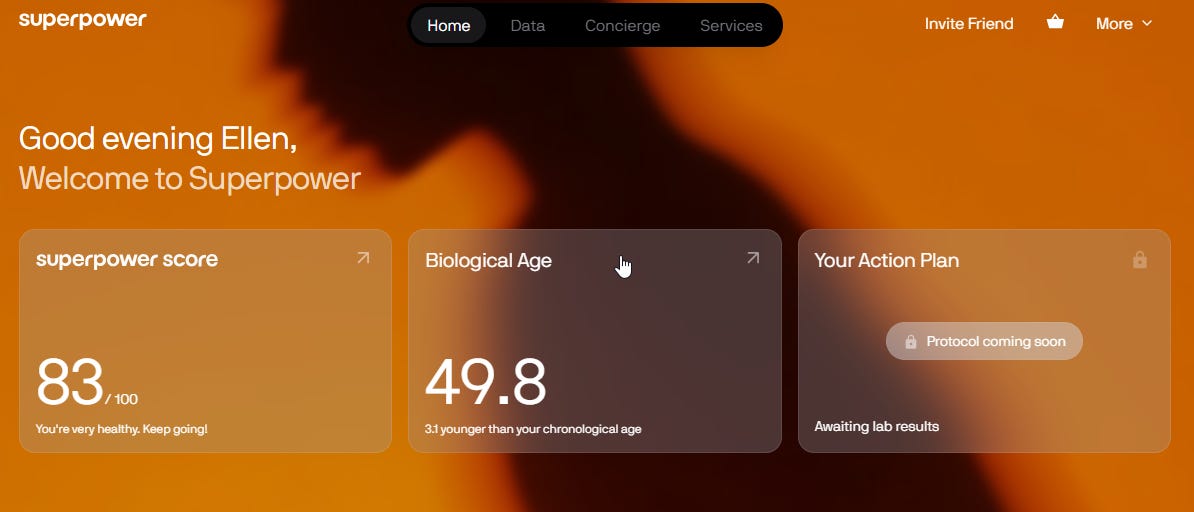 Superpower app screen displaying a member's biomarker results and biological age
Superpower
100+ biomarkers included for $199 a year
24/7 care team and concierge support
17 health scores plus a biological age readout
HSA/FSA eligible, with add-on toxin, gut, and cancer screening
Only one panel included per year; extras cost more
At-home draw is a paid add-on
Not available in every US state
Published no-refunds policy, and a blood draw is required
What are the pros and cons of Function Health?
Function Health focuses on depth and repeat testing. Its $365 membership covers 160+ lab tests, testing twice a year plus on-demand options, and a clinician review on every result functionhealth.com.
Access is wide. Draws run through 2,000+ lab locations. No insurance is needed, and the fee is HSA/FSA eligible.
The main drawback is cost. At $365 a year it runs close to double Superpower's entry price. Like any blood panel, it still needs a needle. The higher cost makes it a heavier commitment for someone who only wants a single yearly snapshot.
 Function Health marketing screenshots of platform functionality
Function Health
160+ lab tests, more markers than Superpower's base panel
Testing twice a year plus on-demand retesting
Clinician review attached to every result
At $365 a year, close to double Superpower's entry price
A blood draw is still required
Superpower or Function Health: which should you pick?
Pick on budget and how often you want to retest. Superpower wins on price and gets you a broad first look for $199, backed by a 24/7 care team superpower.com. Function Health wins on depth and cadence, with 160+ tests and two included rounds a year for $365 functionhealth.com.
If you want one wide annual baseline without spending much, Superpower is the leaner choice. If you plan to track markers across the year and want a clinician reading each result, Function Health earns its higher fee.
Whichever you choose, the panel is a starting point. The value comes from acting on the numbers with a clinician who knows your history.
Before you subscribe, check that your state is covered by Superpower and confirm which markers matter most to you, so you are not paying for depth you will not use.
Choose Superpower if you want one affordable annual snapshot with support available at any hour. Choose Function Health if you want more markers, more retesting, and a clinician reading every result across the year.
Superpower for the lowest-cost broad baseline; Function Health for deeper, more frequent testingAs published, Superpower delivers a 100+ biomarker panel for $199 a year with a 24/7 care team, while Function Health covers 160+ tests with twice-yearly plus on-demand retesting and per-result clinician review for $365.
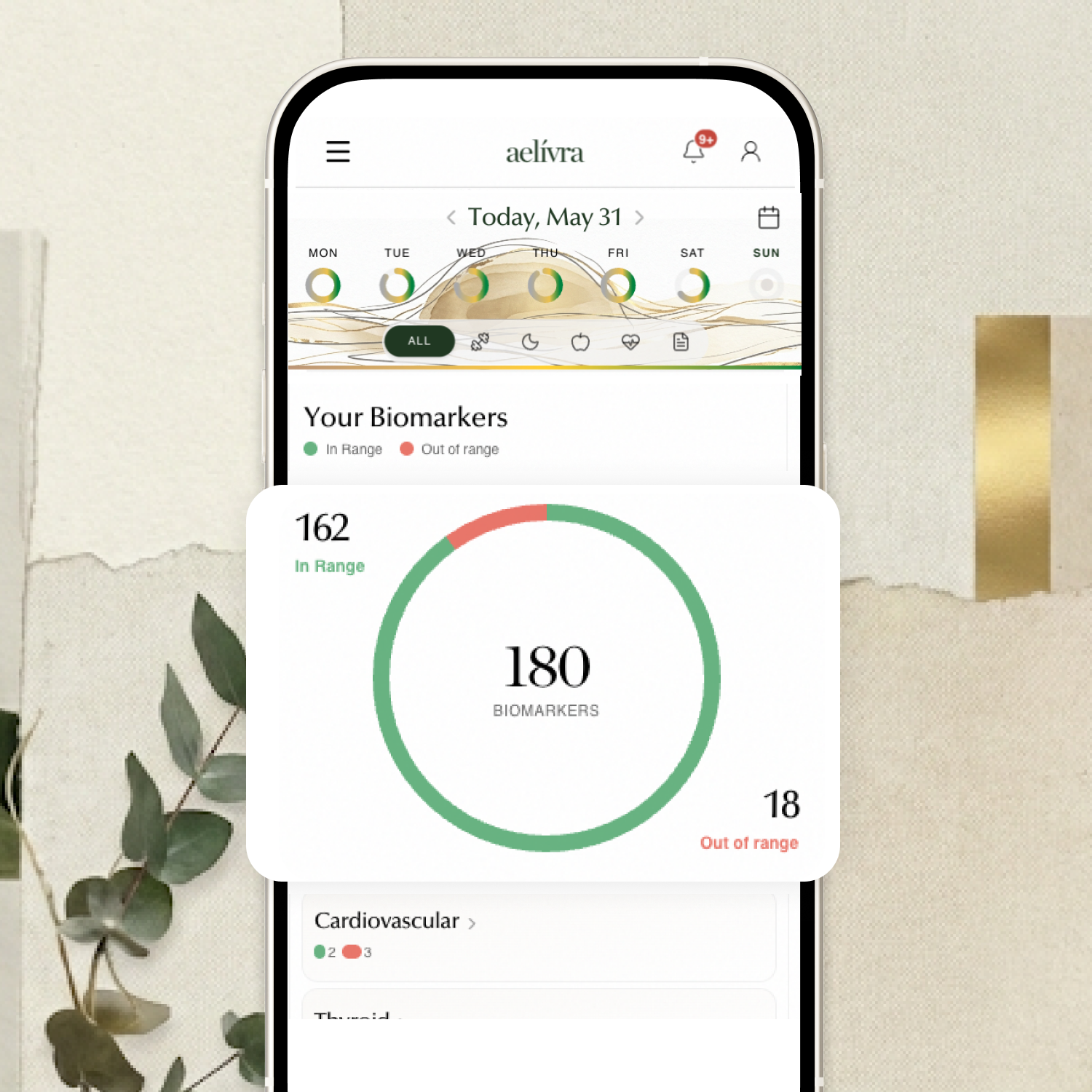
Blood work, scans, test results, medical reports — finally in one place and connected to how you actually feel. aelívra tracks biomarkers and health records over time, so you can see what's trending in the right direction and walk into your next appointment knowing exactly what to discuss.
Superpower vs Function Health: common questions
Is Superpower cheaper than Function Health?
Yes. As published, Superpower is $199 a year and Function Health is $365 a year superpower.com. Superpower includes fewer markers and one panel; Function Health includes more markers and twice-yearly testing.
How many biomarkers does each service test?
Superpower lists a 100+ biomarker annual panel, and Function Health lists 160+ lab tests, per each company's site.
Do Superpower and Function Health require a blood draw?
Yes, both require a blood draw. Superpower offers 2,000+ Quest locations or a paid at-home draw; Function Health uses 2,000+ lab locations.
Are these memberships HSA or FSA eligible?
Both publish that their membership fees are HSA/FSA eligible, and Function Health states no insurance is needed.
Which is better for tracking results over the year?
Function Health builds in twice-yearly plus on-demand retesting, while Superpower includes one panel a year with extra tests at added cost functionhealth.com.
Function Health publishes testing twice a year plus on-demand retesting, so you can see a flagged marker change within the year. A single annual panel means a twelve-month wait.
Sources

Cameron founded aelívra after years of living an unknown no one could answer — navigating chronic health complexity through a medical system that wasn't built for it. That experience became a conviction: everyone deserves to feel truly alive, and no one should have to accept not knowing as a way of life. His work sits at the intersection of data science and functional health and wellbeing, turning the latest trusted medical research across news, health, wearables, biomarkers, and more into advice everyday people can use on their journeys toward feeling better. Every article is grounded in peer-reviewed evidence and linked to its primary source. This content is for informational purposes only and does not replace medical advice.