Summary at a glance
Rythm Health advertises $79 a month, but independent first-person totals run $98 to $101 once shipping and tax are added — roughly $1,210 a year.
The needle-free collection is the one thing every source agrees on: reviewers with blood phobia describe completing a blood test alone at home.
Users who ran Rythm beside a Quest or hospital draw report the largest gaps in hormone results, while others report close matches — treat it as a trend tracker, and keep reference-lab testing for decisions.
Rythm's biomarker page lists 30 markers, with no A1c, fasting insulin or full CBC, and haemoglobin and haematocrit are offered to male users only.
238 of the 258 Trustpilot reviews we read in July 2026 arrived through company-sent invitation links, so read the profile's 89% five-star share in November 2026 with that in mind.
This review aggregates publicly available user reviews, forum threads, video reviews and one published tester account. We have not used Rythm Health first-hand. Blood results — including hormone, cholesterol, kidney and liver markers — need clinical context, and a value inside or outside a reference range is not a diagnosis. Rythm states that it does not provide medical advice, diagnosis or treatment, and its FAQ says a state-licensed physician signs off every result before you see it. Talk with a licensed clinician before acting on any panel result or changing medication, hormone therapy or supplements. Pricing and the biomarker list were checked in November 2026 and availability in July 2026, and all may change.
Is Rythm Health Worth It?
Rythm Health is worth it for one job: a small blood panel, repeated monthly, with no needle and no lab visit. Reviewers rate the collection as painless. They disagree far more about the numbers it returns. The advertised $79 a month comes to about $101 once shipping and tax are added.
We have not used Rythm ourselves. This verdict aggregates what other people report.
This disagreement runs through the whole review. People with blood phobia describe finishing a blood test alone at home for the first time trustpilot.com. Users who ran Rythm beside a Quest draw describe hormone results that did not line up. Both groups exist. Your experience depends on what you do with the number.
People who want a small panel re-tested every month at home, alongside occasional reference-lab bloodwork.
Rythm At-Home Blood Test ($79/mo advertised, around $101 all in)Aggregated reviews call the needle-free monthly collection painless and the trend view useful. The same reviews include several user comparisons where hormone values diverged from reference-lab draws.
Blood work, scans, test results, medical reports — finally in one place and connected to how you actually feel. aelívra tracks biomarkers and health records over time, so you can see what's trending in the right direction and walk into your next appointment knowing exactly what to discuss.
What is Rythm Health?
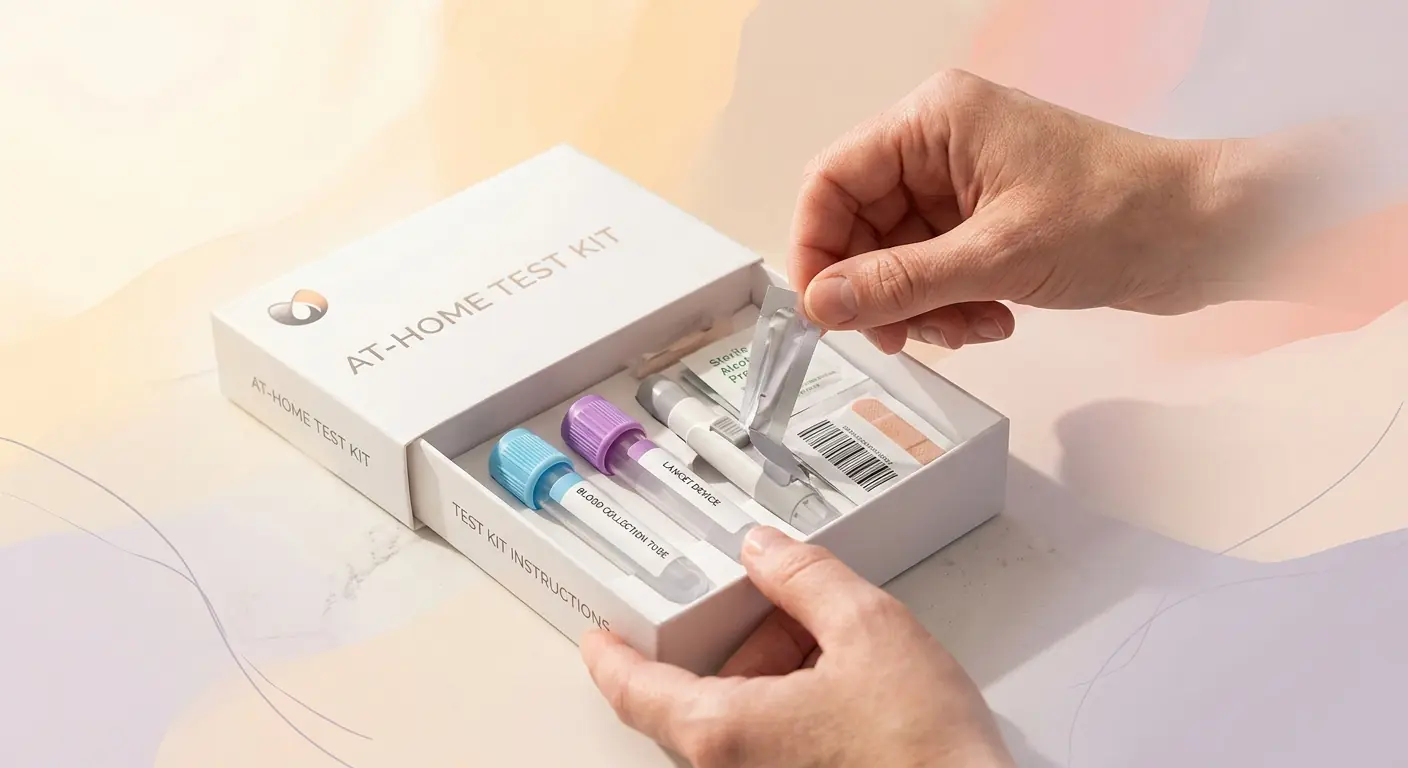
Rythm Health is a monthly at-home blood test subscription. The kit uses a push-button collector that sits on your upper arm. It uses adhesive and a small blade, with no needle. FedEx picks the sample up from your house for free. Rythm says results are available within 48 hours once your sample begins processing.
Rythm designed the panel to be small. Rythm advertises "25+" biomarkers and its own biomarker page lists 30, of which 3 are computed ratios. An analyst who compared testing services counted roughly 22 distinct markers dennisyu.com.
Rythm runs as a web app you save to your phone's home screen. Rythm's FAQ says a state-licensed physician signs off every result before you see it. Interpretation comes from an AI coach, plus a Rythm Score and biological age estimate.
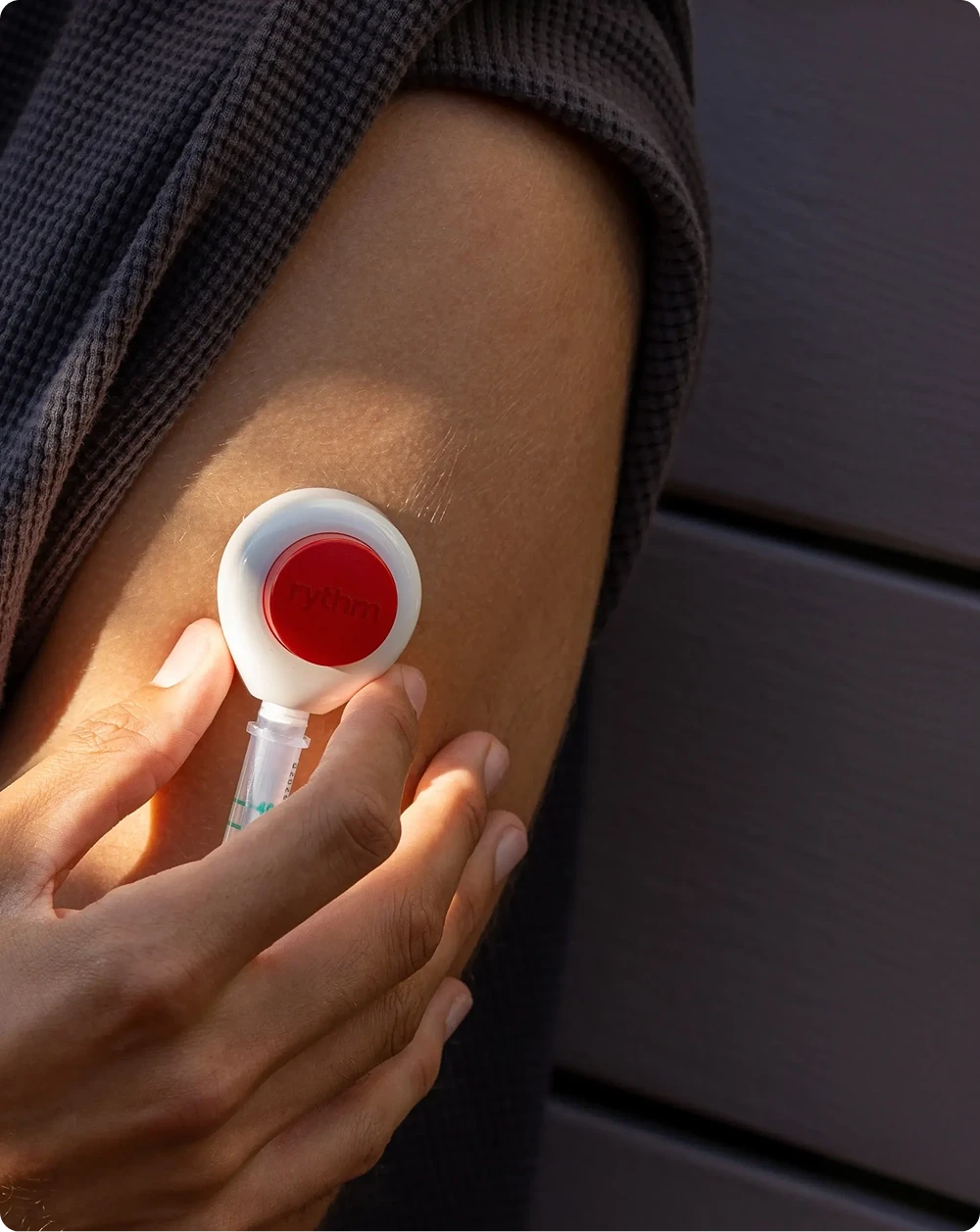 Rythm collector held against the upper arm
How much does Rythm Health cost?
Rythm charges $79 a month, plus shipping and tax, which add a large amount. The shipping amount is not shown before you create an account.
Independent reports give similar totals. A forum member reported $98 at signup in November 2025. A self-funded tester's May 2026 order came to $91.75 on a promotion, against a $101 regular rate geekmamas.com.
A four-star Trustpilot reviewer in July 2026 wrote: "it is $101.00 all in every month" trustpilot.com. One two-star reviewer called the gap a bait and switch. Budget for about $100 a month.
At $101 a month, a year of Rythm comes to roughly $1,210.
A first month ran $59.25 with the 25% promotion Rythm advertised in July 2026. You can skip up to 90 days at a time, or cancel with no fee. Rythm is HSA and FSA eligible. The money-back guarantee covers your first order only.
The checkout total is higher than the advertised $79. Independent first-person totals in the reviews we read run $98 to $101 a month once shipping and tax are added.
Advertised monthly price
$79/mo + shipping and tax
First month with the July 2026 promotion
$59.25 (25% off offer)
Reported signup total
$98
Reported regular monthly total
$101
Twelve months at the reported rate
around $1,210
Advertised monthly price
Rythm's own product page, checked July 2026
First month with the July 2026 promotion
Rythm offer page, checked July 2026
Reported signup total
Forum member, November 2025
Reported regular monthly total
Published tester and a Trustpilot reviewer, mid-2026
Twelve months at the reported rate
Calculated from the $101 all-in figure
What do users like about Rythm Health?
Every review we read agrees that the collection does not hurt.
For many users, the main benefit is relief from the fear of needles. Trustpilot reviewers who faint at venepuncture describe getting through it alone. One Reddit user with what they called "crippling anxiety around blood work" said the vial filled in two minutes and they felt nothing reddit.com. This matters most to people who have avoided blood draws for years.
The monthly cadence is the second thing people value. Someone adjusting a testosterone dose can watch a marker move month over month. An annual panel cannot do that.
Access is the third benefit. Uninsured reviewers and perimenopausal women describe insurers who would not help. One reviewer's result flagged hyperthyroidism, which a PCP confirmed before referring them to endocrinology.
 Rythm app showing biological age and overall score
Rythm Health
The collector does not hurt, and reviewers with blood phobia describe finishing their first test alone at home
Monthly testing makes a diet, dose or supplement change visible in a way an annual panel cannot
Results often land within days of collection, with free FedEx pickup from your door
Cheap against US clinic pricing for the same hormone markers, and HSA/FSA eligible
Failed kits are replaced free, and you can skip up to 90 days or cancel with no fee
Hormone values have diverged from same-week Quest and hospital draws in several user comparisons
30 listed markers, with no A1c, no fasting insulin and no full CBC
The $79 headline resolves to roughly $101 once shipping and tax are added
Collections fail for a minority: slow flow, clotting, and a cut that occasionally scars
An AI coach provides the interpretation, and Rythm does not diagnose, treat or prescribe
What are the most common Rythm Health complaints?
Accuracy is the most important complaint. The evidence is anecdotal, and it points in both directions.
One user in r/Biohackers collected her Rythm sample within an hour of a scheduled Quest draw. No other user compared the two more closely. Her results ran at least 20 points higher, and Rythm refunded her reddit.com. Her doctor said Rythm is fine for comparing Rythm results with each other, but it does not replace a Quest draw.
Something similar happened to a self-funded tester with a quarterly lab baseline. Most of her panel matched, but her testosterone came back unnaturally high geekmamas.com. Her prescribing doctor blamed a known weakness: immunoassay testing at female testosterone levels.
Some evidence points the other way. The most-cited Reddit accuracy thread partly undermines its own author's claim reddit.com. He had added a drug between draws that crashed his SHBG. One forum member reports Rythm results tracking closely with a Marek Health panel on the same dose anabolicsteroidforums.com.
No study has settled the question. Every reported gap involves hormones.
Other complaints are simpler. Haemoglobin and haematocrit come back blank for some subscribers, which is a problem for people on testosterone therapy. Rythm's biomarker listing explains part of it: both are male-only.
Logistics failures cause serious problems. Reviewers describe FedEx refusing packages and pickups that never happened. Support has no phone line to escalate to.
Several users who ran Rythm beside a Quest or hospital draw report hormone values that did not match. If a result would change your medication or hormone dose, confirm it with a reference-lab draw first.
Who should use Rythm Health?
Rythm suits people who want to monitor markers between full lab visits. People who fear needles benefit most, because this may be the only way they test at all. Uninsured people come next, alongside anyone whose doctor will not order the markers they care about. Both groups get the most value by also having occasional venous bloodwork.
Skip it if you want breadth.
Rythm's 30 listed markers are a fraction of what Function Health or Superpower return for an annual fee. Rythm states that it does not offer medical advice or a diagnosis. If you are on testosterone therapy and need haematocrit tracked, check the current panel first.
It is US only, 18 and over, with no P.O. boxes and no Puerto Rico.
 Rythm wordmark on a near-black background
How we researched this review
We did not test Rythm first-hand. This review aggregates public user sentiment captured on 29 July 2026.
Sixteen sources contribute. Three more show what we could not use. Trustpilot supplied 258 reviews captured verbatim from a 2,232-review profile, all within twelve months. We read in full nine Reddit threads, an unofficial subreddit and a 53-post forum thread, plus two YouTube reviews and one published tester.
Two audience skews matter here. The largest Rythm discussion anywhere is a 237-comment thread in r/medlabprofessionals, whose members are clinical laboratory scientists and phlebotomists, and who are not customers reddit.com. They give a technical critique of the collection method. Most other Reddit material comes from testosterone-therapy boards.
Every voice outside Reddit and Trustpilot carries a caveat. Both YouTube reviews carry a referral link. The published tester bought her own kit but earns $20 per referral. The analyst wrote that he came across Rythm in October 2025 and flagged it as worth investigating, so his piece covers the panel's scope.
Trustpilot needs its own caveat. Of the 258 reviews captured, 238 arrived through company-sent invitation links trustpilot.com.
Read the profile's 85.7% five-star share in July 2026 with Rythm's invitation pipeline in mind.
Rythm runs a two-sided $20 referral programme. One Reddit account posted a near-identical positive review with the same referral code across four separate threads before another user called it out.
Facts on this page were checked against saved copies of each source on 11 November 2026.
Common questions about Rythm Health
How much does Rythm Health cost?
The advertised price is $79 a month plus shipping and tax. Reviewers report real totals of $98 to $101, about $1,210 a year.
Is Rythm Health accurate?
Users who compared it against Quest report the biggest gaps in hormone results, especially testosterone. Others report close matches. Track Rythm against itself, and keep a reference lab for anything you plan to act on.
How many biomarkers does Rythm Health test?
Rythm advertises "25+" and its biomarker page lists 30, three of them calculated ratios. That list, checked in November 2026, measures blood sugar with fructosamine, and its CBC Essentials group holds only hematocrit and hemoglobin, for men only.
Is Rythm Health better than Function Health or Superpower?
Function Health and Superpower return far broader panels for their yearly fee. Rythm lists 30 markers, tested every month, needle-free.
Sources

Cameron founded aelívra after years of living an unknown no one could answer — navigating chronic health complexity through a medical system that wasn't built for it. That experience became a conviction: everyone deserves to feel truly alive, and no one should have to accept not knowing as a way of life. His work sits at the intersection of data science and functional health and wellbeing, turning the latest trusted medical research across news, health, wearables, biomarkers, and more into advice everyday people can use on their journeys toward feeling better. Every article is grounded in peer-reviewed evidence and linked to its primary source. This content is for informational purposes only and does not replace medical advice.