
Summary at a glance
A normal vitamin B12 level for energy and focus sits above 300 pg/mL, though standard lab ranges often consider lower numbers acceptable.
You can experience severe fatigue and brain fog even when your total B12 blood test returns normal results.
Cognitive decline and nerve damage can begin in the 'grey zone' before you reach the official clinical threshold for deficiency.
Methylmalonic acid (MMA) testing provides a highly accurate way to confirm a true cellular B12 deficiency.
Wait at least three months after starting supplements to retest your blood, ensuring your cells have actually absorbed the nutrient.
What Is a Normal Vitamin B12 Level for Energy and Focus?
A normal vitamin B12 level for energy and focus sits above 300 picograms per milliliter (pg/mL). Levels between 200 and 300 pg/mL fall into a grey zone where you might still experience fatigue. Anything below 200 pg/mL indicates a clear clinical deficiency that requires treatment.
When you check your lab results, the numbers can feel confusing. Different laboratories use slightly different reference ranges.
MedlinePlus (2026) reports that normal values range from 299 to 1,054 pg/mL medlineplus.gov. If your results land near the bottom of this range, your cells might not be getting the fuel they need. You could still feel exhausted even though your paperwork says you are fine.
| Status | Range (pg/mL) | Clinical Meaning |
|---|---|---|
| Optimal / Normal | 300 – 1,054 | Sufficient for cell energy and nerve protection. |
| Borderline | 200 – 299 | Grey zone. You might experience subtle fatigue or brain fog. |
| Deficient | < 200 | High risk for anaemia and nerve damage. Needs attention. |
Can You Be Deficient if Your B12 Test Result Is Normal?
Yes, you can be functionally deficient in vitamin B12 even if your standard blood test returns a normal result. Standard tests measure the total amount of B12 in your blood, but they cannot tell you how much of it is actually usable by your body.
Consultant Biochemist Moya O'Doherty at the Royal United Hospitals Bath (2024) states that total vitamin B12 tests are poorly performing with poorly defined ranges, meaning your blood results might not match the vitamin concentration inside your cells ruh.nhs.uk.
This discrepancy explains why you might feel completely drained while your doctor says your labs look perfect. Your body requires the active form of the vitamin to function. If most of your measured B12 is bound to inactive proteins, your nerves and muscles will still struggle.
If your blood work is normal but your fatigue persists, ask your healthcare provider about testing your active B12 or methylmalonic acid levels.
How Does Vitamin B12 Impact Brain Fog and Cognitive Aging?
Vitamin B12 directly protects your brain by helping to form the myelin sheath, which is the insulating layer around your nerves. When your levels drop, this protection breaks down, and your nerve signals slow down. This leads to the mental sluggishness you recognise as brain fog.
The Quadram Institute (2025) reports that a study of 231 healthy volunteers with an average age of 71 found more signs of neurological damage in those with lower B12 concentrations quadram.ac.uk.
The Quadram Institute (2025) reports that a level below 180 nanograms per litre is considered deficient in the UK, while the US uses a 200 ng/L cutoff quadram.ac.uk. Regardless of the exact number, your brain feels the decline early. Replacing the missing nutrient can often sharpen your focus and protect your long-term memory.
The UK and the US use different thresholds for vitamin B12 deficiency, but cognitive decline can begin long before you hit either number.
Why Do Low B12 Levels Cause Persistent Fatigue?
Low vitamin B12 levels cause fatigue by disrupting how your body creates red blood cells. Without enough B12, your body produces red blood cells that are abnormally large and oval-shaped. These oversized cells struggle to carry oxygen efficiently.
When your muscles and tissues lack oxygen, your energy crashes. You will feel a heavy, profound exhaustion that sleep cannot fix. This physical exhaustion is often mistaken for simple burnout. Understanding the difference between Chronic Fatigue Syndrome vs Burnout can help you advocate for the right tests.
Your central nervous system also relies on this vitamin for basic development and daily function ods.od.nih.gov. When your nervous system is starved of nutrients, every movement feels like it requires extra effort. Your limbs might feel like lead, and recovering from minor physical exertion can take days instead of hours.
 A close-up view of a laboratory test tube representing biomarker screening for energy levels.
When Should You Ask for an MMA Test to Confirm Your B12 Status?
Asking for a methylmalonic acid (MMA) test is crucial if your B12 results are borderline but you still suffer from fatigue or numbness. A high MMA level confirms a true B12 deficiency because your body produces more MMA when it lacks the active vitamin.
MedlinePlus (2026) reports that deficiency should be confirmed by checking the level of methylmalonic acid in the blood medlineplus.gov. This secondary test removes the guesswork. It tells you exactly what is happening at the cellular level.
If you experience tingling in your hands, weakness, or loss of balance, an MMA test provides vital clarity medlineplus.gov. You do not have to accept feeling terrible just because a basic screening test missed the problem. Many people spend years chasing the wrong diagnosis simply because their doctor never looked beyond the standard total B12 panel.
Methylmalonic acid builds up in your blood only when your cells are actively starved of vitamin B12.
How Often Should You Retest Your Vitamin B12 Levels?
Retesting your B12 levels three months after starting supplementation gives your body enough time to build up intracellular stores. Testing too soon will only show the supplement floating in your blood, not what your cells have actually absorbed. This can create a false sense of security regarding your progress.
MedlinePlus (2026) reports that fasting for 6 to 8 hours before your blood test ensures accurate readings medlineplus.gov. Fasting guarantees your results are not temporarily spiked by a recent meal. If you struggle with energy dips around meals, exploring how to stop feeling tired after eating can help balance your day.
Tracking how you feel between blood draws is incredibly valuable. When you bring clear data to your doctor, you shift the conversation from vague complaints to undeniable patterns. aelívra helps you track symptoms with context. You can map your daily energy and brain fog against your changing lab results. This makes it much easier to see if your new routine is actively working.
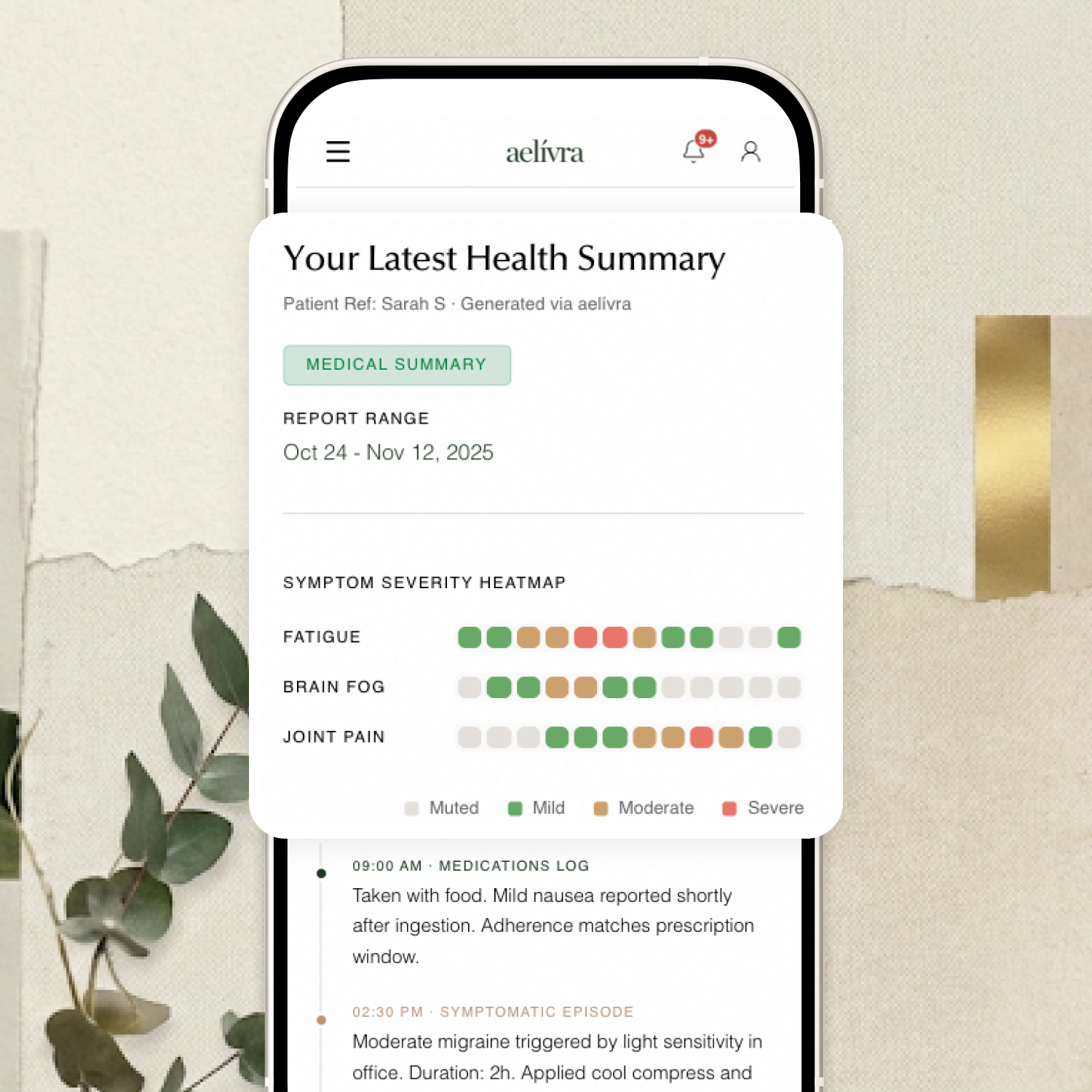
Shift the conversation from "I just don't feel right" to clear data your doctor can act on. aelívra turns weeks of health data into clean, visual summaries — so time-limited consultations focus on patterns, not guesswork.
Frequently Asked Questions
Can you be sick with normal blood work? Yes. Standard tests measure total B12, but much of that might be inactive. You can experience severe fatigue and cognitive issues even when your total levels look fine on paper.
Do you need to fast before a B12 blood test? Your healthcare provider may ask you to fast. It is generally recommended to avoid food and drink for 6 to 8 hours before the draw to ensure accurate baseline readings medlineplus.gov.
What are the first signs of a B12 deficiency? Early signs often include brain fog, subtle memory glitches, and physical fatigue. As the deficiency worsens, you might notice tingling in your hands and feet or a loss of balance medlineplus.gov.
Does B12 give you immediate energy? Vitamin B12 is not a stimulant. It restores your body's natural ability to carry oxygen and protect nerves. You will notice a steady return of your natural energy over weeks rather than an immediate rush.