Summary at a glance
Visible's research app is free, membership costs $19.99 a month or $239.88 a year, and Visible Band 2.0 is a separate $79.70 purchase on the monthly plan and free with the annual plan.
Users credit continuous heart rate and pace points with making invisible exertion visible in real time, which changes what they do next.
The pricing objection is structural: a subscription layered on hardware you already bought, sold to people for whom disability income is common.
Band-to-app disconnection recurs across app-version-stamped Google Play reviews from March to July 2026, each one naming the version it happened on.
This review aggregates public user sentiment from 25 sources collected in July 2026. We did not test Visible first-hand.
This review aggregates publicly available user reviews, community threads and published tester accounts. We have not used Visible first-hand. Pacing is a way to manage post-exertional malaise in ME/CFS, Long Covid, POTS and related conditions. It is not a treatment, and no app or heart-rate band diagnoses, treats or reverses these illnesses. Heart-rate and HRV readings need clinical context, and a score inside or outside a normal range is not a diagnosis. Talk with a clinician before changing your activity levels, medication or care. Pricing was checked in November 2026 and availability in July 2026, and both may change.
Is the Visible Band Worth It?
Visible is worth it if you are newly ill and still learning what each activity costs your body. Users across Reddit, Trustpilot and the app stores say the pacing alerts change behaviour. The same users call the subscription steep and the band unreliable. We have not tested it first-hand.
Pacing is a way to manage post-exertional malaise. It does not treat the illness.
Every source we read shows the same split. One group describes learning that a shower counts as exertion, then pacing around it. Another describes a band that keeps losing its connection to the app. Both are writing in good faith.
Newly diagnosed mild-to-moderate ME/CFS, Long Covid or POTS, while you are still learning where your limits sit.
Visible annual membership plus Band 2.0Aggregated reviews say the pace points and over-exertion alerts change behaviour, and the graphs get clinicians to listen. The same reviews report the band losing its connection, and a fee charged on top of hardware you already own.
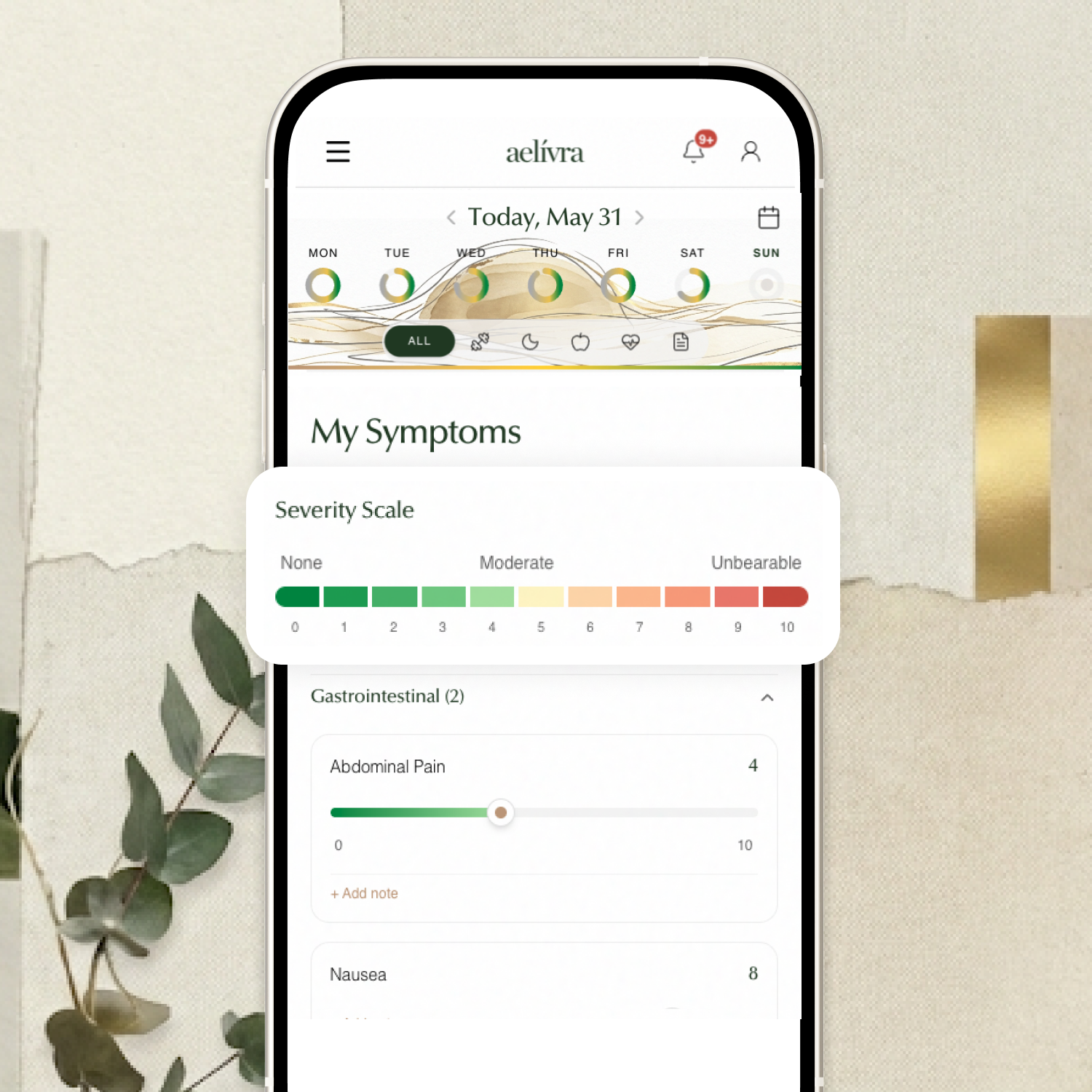
Every check-in brings you closer to answers. Effortlessly build a clear picture of energy, mood, pain, and sleep over time — so you can see exactly what's improving, what's not, and feel confident you're doing the right things to feel better.
What is Visible?
Visible is a pacing app and armband built for energy-limiting chronic illness: ME/CFS, Long Covid, POTS and fibromyalgia. Visible is designed to help you do less, where a fitness tracker pushes you to do more.
Visible has two tiers. The free research app tracks symptoms, gives you a Morning Stability Score, reads HRV through your phone camera and lets you join Visible's research studies makevisible.com. The paid membership adds PacePoints, a personal energy budget you spend across the day. It also brings over-exertion alerts and reports for your clinician.
The alerts only work with the Visible band.
Visible Band 2.0 is a continuous heart-rate band with a battery that lasts up to 10 days per charge, according to Visible's tech specs page in November 2026, and a screenless waterproof body. Visible's FAQ, captured in July 2026, says "we don't support other wearables like Apple Watch, Fitbit, or Garmin". Sleep tracking is an opt-in feature in the app's Early Access Hub.
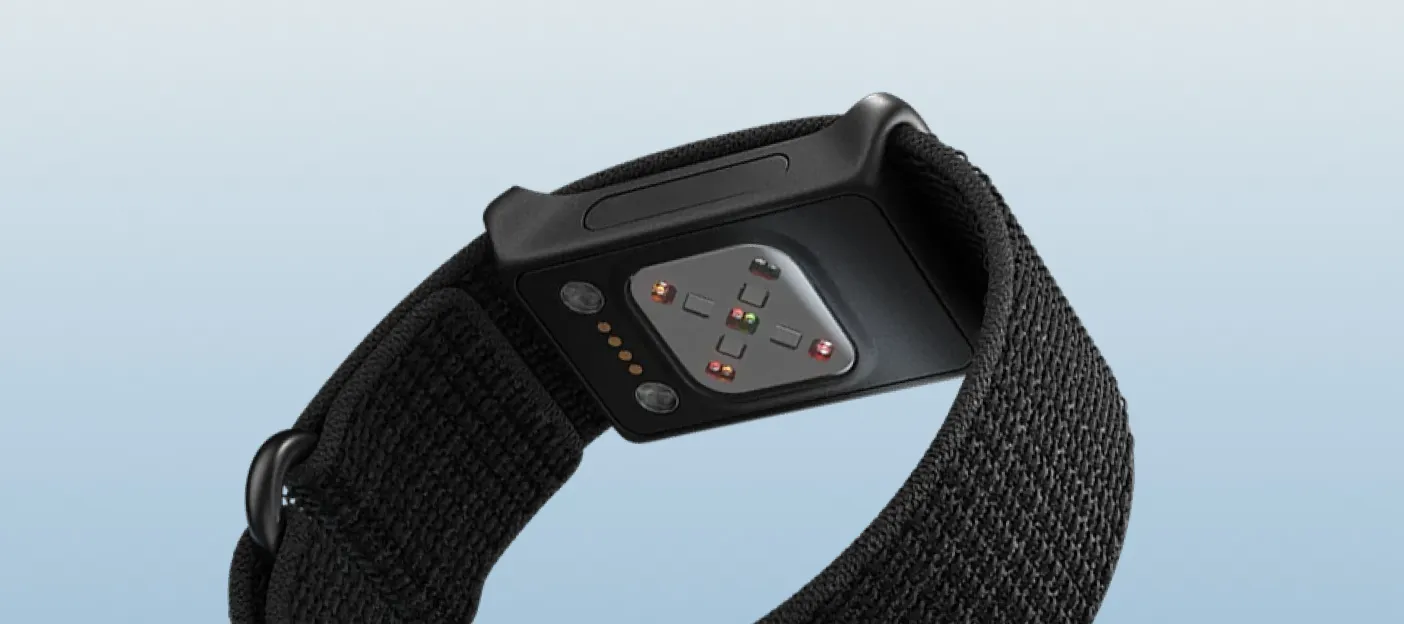 Visible armband showing its underside sensors
How much does Visible cost?
The app itself is free. Membership is $19.99 a month, $239.88 a year, or $359.76 for two years, which works out at $14.99 a month makevisible.com. Visible Band 2.0 is a separate one-off purchase at $79.70 on the monthly plan, and free with the annual and two-year plans.
Band plus a first year of membership comes to $239.88 on the annual plan.
Users in every source object to this pricing structure. Buyers pay for hardware, then keep paying to see what it is already measuring. One Reddit commenter called it "extremely predatory", in a January 2026 thread of people doing the sums against disability income reddit.com.
Users raise a second problem. In a December 2025 comment, a Reddit user notes that people who stop subscribing lose sight of their own data reddit.com.
On the monthly plan, the band and the membership are two separate purchases. Price both before you commit, and check availability first, because membership is sold in the US and the UK only.
Free research app
$0
Monthly membership
$19.99/mo (USD, checked 2026-11-10)
Annual membership
$239.88/yr = $19.99/mo, band free (USD, checked 2026-11-10)
Visible Band 2.0 (hardware)
$79.70 one-off on the monthly plan; free with annual or 2-year (USD, checked 2026-11-10)
Free research app
Symptom tracking, Morning Stability Score, Smartphone-camera HRV, Research study enrolment
Monthly membership
•
Personalized PacePoints budget
•
Real-time over-exertion alerts
•
Activity tagging
•
HRV biofeedback breathing
•
Health reports export
•
Dedicated support team
Annual membership
•
Personalized PacePoints budget
•
Real-time over-exertion alerts
•
Activity tagging
•
HRV biofeedback breathing
•
Health reports export
•
Dedicated support team
Visible Band 2.0 (hardware)
•
Continuous heart-rate band
•
Wrist strap
•
Battery up to 10 days per charge (Visible's tech specs page, November 2026)
•
Waterproof screenless design
What do users like about Visible?
Most praise is about seeing exertion as it happens. Continuous heart rate and pace points show a delayed, invisible illness on a screen.
People describe learning that ordinary acts cost them: a car journey, one spoken sentence, the walk to the bathroom. Seeing that cost changes what they do next. "It MAKES me pace more. The pace points are everything," one r/cfs commenter wrote in October 2025 reddit.com.
The second theme is medical. Members bring the graphs to appointments and get taken seriously; one user's heart-rate spike data led their doctor to prescribe ivabradine reddit.com.
Users also like Visible's focus on rest.
Fitbit congratulates you on your cardio, and Apple Watch asks you to close its activity rings. When your main risk is doing too much, that encouragement is bad advice. Reviewers say Visible was the first tool that told them to do less.
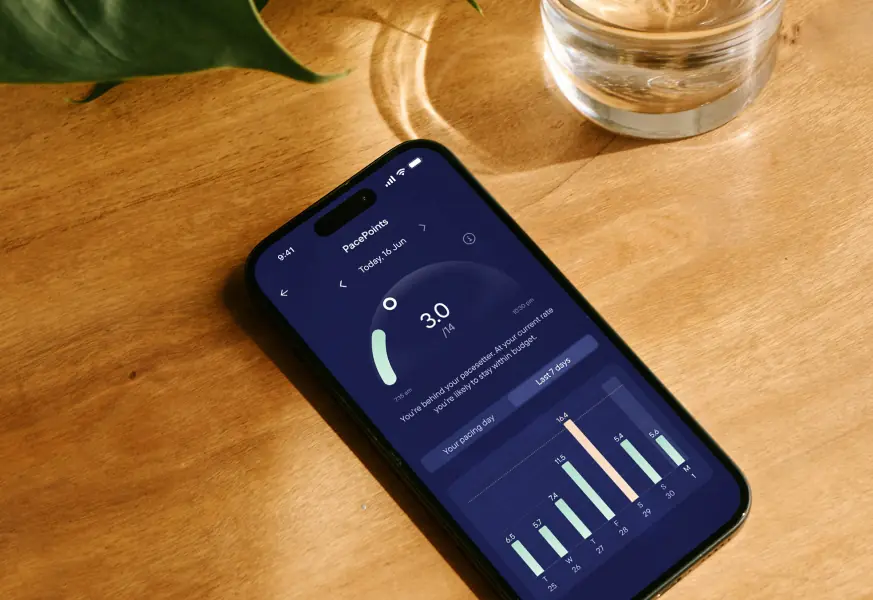 Visible app showing pace points and a weekly chart
Visible
Pace points and over-exertion alerts change behaviour during the activity
Heart-rate graphs give clinicians something concrete, and users report diagnoses and prescriptions that followed
Built around rest, where Fitbit, Garmin and Apple Watch are built around movement
Support is often fast and human, and some of the staff live with the same conditions
The band unpairs from the app, and the reset routine costs energy users do not have
A subscription sits on top of hardware you bought, and stopping it hides your own history
Skin reactions are common, from contact dermatitis and itching to reported burns
The Morning Stability Score often contradicts how people feel that morning
Support outcomes are uneven: long waits on faulty bands, readings left unresolved for months, and one unverified report of a chat bot replacing staff
What are the most common Visible complaints?
Connectivity is the loudest complaint, and the easiest to check.
Google Play reviews carry app-version numbers, so each report can be matched to an app version. "It unpairs every 10-15 days," one reviewer wrote in April 2026 play.google.com. Others describe it dropping between rooms, or after an app update. Fixing it takes a manual reset that costs focus and energy people do not have.
The Morning Stability Score loses users' trust more than any other feature. One user woke mid-crash and was told to expect a good day. They said they felt gaslit reddit.com. Experienced members push back on this. They say the score measures how far you have drifted from your average over about 90 days, which is a separate thing from how well you feel. Defenders add that Visible explains this worse than its users do.
Skin reactions are the next complaint, mostly contact dermatitis and itching from the strap. One June 2026 account describes burns and scarring where the sensors sit play.google.com.
Some users also distrust the company. They say the social ads imply an automation the product does not deliver. A 2024 Reddit post alleged Visible deleted a critical review and blocked the reviewer reddit.com. Visible told the poster an algorithm caused it. The allegation remains single-source and unresolved.
The Morning Stability Score measures how far you have drifted from your own average over about 90 days. A crash day can still score highly, because the score tracks that drift and ignores how you feel.
Who should use Visible?
Visible fits best if you are early in an energy-limiting illness and still mapping your limits. Mild to moderate ME/CFS, Long Covid and POTS are its stated design target.
It suits severe illness poorly.
Bedbound patients report it tells them little they did not know, since they are always resting. The daily check-ins cost energy they cannot spare. People who left in 2026 say accessibility requests went unanswered for a long time. Visible has said openly that it designed for mild-to-moderate ME/CFS, so the problem is marketing that reaches beyond that group.
Skip it if your exertion is mostly cognitive or social and your heart rate stays flat.
Many people use Visible for a limited period. Some subscribers learn what they need in a year or two, then cancel while still recommending it to the newly diagnosed. Another cancelled at six months and wrote: "It really is just a heart rate monitor" reddit.com.
If you already wear a Garmin, Oura or Whoop, many users say those cover most of the same ground without another subscription. See our Whoop alternatives guide, or Guava Health for tracking without hardware.
 Woman outdoors wearing a Visible band on her wrist
How we researched this review
We did not test Visible first-hand. This review aggregates public user sentiment collected on 29 July 2026: 25 sources and roughly 400 distinct opinions.
We started with Trustpilot. The profile shows 4.7 across 1,175 reviews, 576 of them in the last twelve months (checked 2026-11-10), and 83% sat at five stars when we read it in July 2026 nz.trustpilot.com. For a company selling to a group this vulnerable, that high share is a reason for care.
The rest, read in full:
Our sources have one important gap. The only published tester piece we found covers the older 1.0 band, reviewed in February 2025 by a journalist given a free unit. We found no independent review of Band 2.0.
Referral links and paid social partnerships fill much of the online content about this product. If a glowing review arrives with a discount code, check whether the reviewer earns credit from it.
Facts on this page were checked against saved copies of each source on 11 November 2026.
Common questions about Visible
Is the Visible band worth the subscription?
If you are newly ill and still learning your limits, aggregated sentiment says yes. People credit the pace points and alerts more than the scores. If you already know your baseline, most say the fee is hard to justify. Plenty cancel and keep pacing by feel.
Does Visible work with an Apple Watch, Garmin or Fitbit?
No. Visible's July 2026 FAQ says it does not support them. Pace points and over-exertion alerts need Visible Band 2.0, a separate $79.70 purchase on the monthly plan.
Does Visible track sleep?
Partly. Sleep tracking is an opt-in feature in the app's Early Access Hub, and Visible says availability varies by band, app version and rollout stage. Its July 2026 FAQ said Visible "does not offer any insights on sleep".
How accurate is the Visible band?
A YouTube reviewer comparing the Visible band against a chest strap reports close agreement, though others describe bad misreads.
Can I buy the Visible band in Canada or Australia?
You cannot buy the pacing band there at the moment. Visible sells the band and its membership in the US and the UK only. Would-be buyers in Canada and Australia raise it often.
Sources

Cameron founded aelívra after years of living an unknown no one could answer — navigating chronic health complexity through a medical system that wasn't built for it. That experience became a conviction: everyone deserves to feel truly alive, and no one should have to accept not knowing as a way of life. His work sits at the intersection of data science and functional health and wellbeing, turning the latest trusted medical research across news, health, wearables, biomarkers, and more into advice everyday people can use on their journeys toward feeling better. Every article is grounded in peer-reviewed evidence and linked to its primary source. This content is for informational purposes only and does not replace medical advice.